Welcome to The Policy Lens

Beyond the Headlines

  • The Middle Income Mirage

    Part 1

    Over the past fifty years, the developing world have time and time again, attempted to replicate the economic recovery stories of East Asia. Countries such as India, Indonesia, Brazil, and South Africa have poured billions of dollars into industrial infrastructure and attracted foreign investment on a scale unimaginable just a few decades earlier. Skyscrapers now dominate those same cities which were once marred by famines, multinational corporations operate enormous facilities and domestic technology corporations who compete on the global stage. Yet despite these achievements, the prospect of joining the world’s advanced economies remains just as distant.

    Decades of industrial expansion and economic growth have produced increasingly sophisticated economies without the prosperity experienced by countries such as South Korea and Japan. The reason: beneath these achievements lies a fundamental structural weakness that continues to tighten the grip on much of the developing world. Its economies have modernized far faster than the population workforce sustaining them.

    The centre of this contradiction is in the difference between distribution and productivity of labor. While middle income countries have developed increasingly sophisticated industries, huge swathes of their populations remain to be employed in low productivity agriculture, informal services, and heavy labour occupations that generate a fractional economic output ratio per worker. In India, for instance, agriculture employs almost 40% of the workforce despite contributing less than 20% of national economic output. Contrastingly, in the United States less than 2% of the workforce is employed in agriculture, with the sector contributing approximately just 1% of national GDP. This imbalance creates an economy in which modern, developed industries are forced to coexist alongside millions whose productivity and earnings remain far below those of their compatriots.

    For these countries, the challenge of reaching high-income status depends on their ability to move workers into more productive manufacturing and service employment through middle level jobs while developing the skills necessary to sustain that transition. According to the World Bank’s 2024 World Development Report, only 34 middle-income economies successfully transitioned to high-income status between 1990 and 2023. At the end of that period, 108 countries remained within the middle-income category, collectively housing approximately six billion people. Despite producing more than 40% of global GDP, the median middle-income country’s income per capita has remained below 10% of the American level since the 1970s. This persistent inability to converge with advanced economies is commonly described as the “middle-income trap”, where the economic strategies responsible for lifting a country out of poverty become insufficient to sustain full face development.

    The underlying economic problem is clearer when examining how national output is distributed across the workforce. In the earliest stage of development, agricultural production utilizes a large swathe of the population, often through divided family holdings with limited machinery and access to capital. Despite these workers contribution to national food production, the economic value generated by each worker can remain relatively low in the grand scheme. This situation becomes more pronounced in economies experiencing virtual unemployment, where several family members participate in agricultural production even when the additional labor has gone far past the point of the marginal cost equaling the marginal revenue, therefore diminishing marginal returns. A country can therefore possess millions of technically employed workers while much of its labor remains economically worthless.

    India’s agricultural workforce is the illustration. With approximately 42% of employment concentrated in agriculture, even small differences in productivity between farming and other sectors have massive implications for national income. If agriculture produces roughly 17% of GDP while employing 42% of workers, its output per worker amounts to only around 40% of the national average. The remaining 58% of workers, producing 83% of output, generate more than three times as much economic value as each agricultural worker. This is an illustration of why aggregate GDP increases does not equate to development. The productivity gap between sectors can remain larger than even underdevolped times, even if the GDP expands.
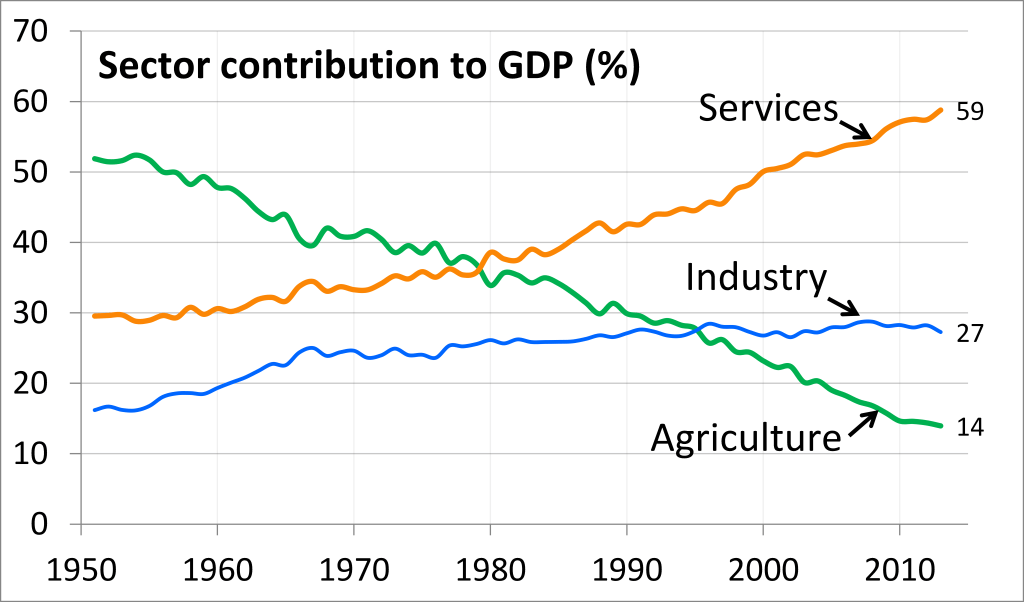
    The distinction between being employed and productive employment is just as important. A worker leaving agriculture to operate machinery in an export-focused factory will experience a major increase in productivity and earnings. Yet a worker leaving the same farm to sell onions informally on a city street will experience a smaller improvement. Both workers have technically moved out of agriculture, but their contributions to economic development will differ substantially. Consequently, the expansion of urban employment does not necessarily indicate that an economy is successfully transforming its productive structure.

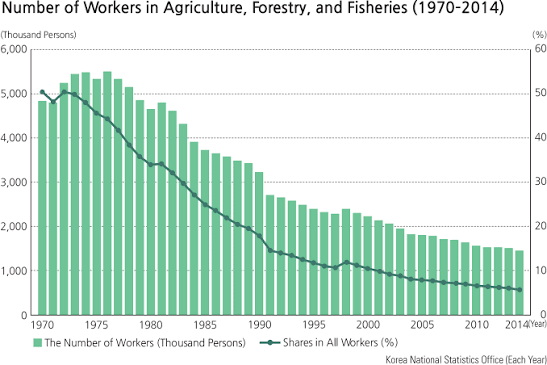
    Historically, some of the most successful examples of the transformation have emerged in East Asia. South Korea provides the clearest illustration of how a overwhelmingly agricultural economy can reorganize its workforce around industrial production. According a World Bank study, agriculture, forestry, and fishing employed 68.3% of South Korea’s workforce in 1960, while manufacturing accounted for just 1.5%. However by 1980, agricultural employment had fallen to 34%, while manufacturing had increased to 21.6%. Another decade later, agriculture employed only 18.3% of workers, with manufacturing accounting for 26.9% and other sectors absorbing the remainder. Within thirty years, South Korea had transferred an enormous proportion of its labor force away from agriculture while developing one of the world’s most sophisticated, deep-set industrial economies.

    This transformation was accompanied by a dramatic restructuring of national production. In 1960, agriculture, forestry, and fishing accounted for 36.9% of South Korea’s GDP, compared with manufacturing’s 13.6%. By 1990, agriculture’s share had fallen to 9.1%, while manufacturing generated 29.2% of national output. The development of shipbuilding, automobiles, steel, and electronics created an increasingly diversified industrial base, while the expansion of education supplied the engineers and technicians necessary to operate it. South Korea’s transformation depended on the continuous expansion of industries capable of employing workers at substantially higher levels of productivity. As agricultural employment declined, industrial production grew sufficiently to absorb much of the labor leaving rural occupations.
    China followed a similar pattern on a much larger scale. Beginning with the economic reforms of the late 1970s, the country slowly opened its economy to foreign investment under Deng Xiaoping, establishing special economic zones which were areas with flexible, market-oriented regulations, tax incentives, and business policies designed to attract foreign direct investment, and expanding manufacturing capacity around major coastal cities. Industrial centers such as Shenzhen became destinations for workers migrating from impoverished rural provinces, where agricultural employment offered much fewer opportunities for higher earnings. Foreign manufacturers brought capital and production methods which had been developed abroad, whilst China’s enormous labor supply allowed industry to expand at baffling speeds.

    The expansion of Chinese manufacturing produced further secondary changes throughout the economy. Industrial employment created derived demand for transportation, construction, and commercial services, creating further opportunities outside agriculture. As cities expanded, their growing concentration of workers and businesses supported increasingly complex supply chains, leading to a virtuous cycle of development.

    Singapore represents a different development trajectory. Unlike China or Korea, the city-state did not possess a massive agricultural workforce to transfer into industrial employment. Its early economic challenge instead involved unemployment, dependence on entrepot trade, and the lack of an industrial base. Following independence in 1965, Singapore expanded attracted foreign manufacturers, initially producing labor-intensive goods such as garments and other consumer products. As wages and industrial capabilities increased, the economy gradually moved toward electronics and precision engineering.

    Singapore’s industrial transformation was followed by the expansion of finance, logistics, and professional services. Rising wages encouraged firms to invest in more machinery and specialized production, while investments in education and technical training helped build workers for increasingly learnèd occupations. Manufacturing continues to contribute more than 17% of Singapore’s GDP, but services account for the majority of economic activity. Its experience depict how advanced economic development can sustain manufacturing alongside an expanding service economy.

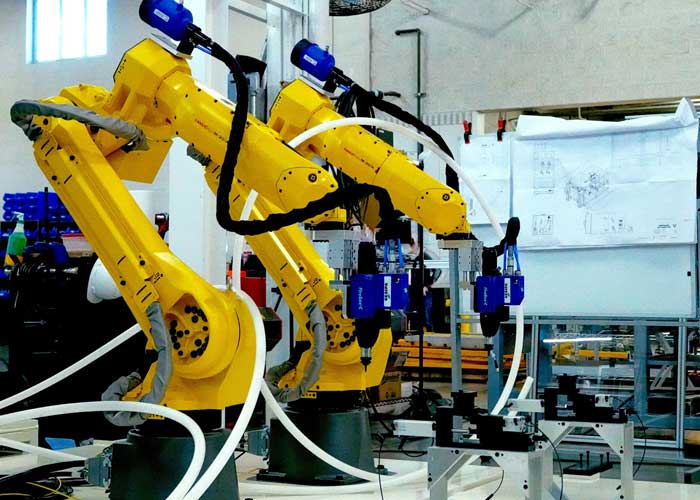
    Yet this all rests on an increasingly questionable assumption: that the industries which absorbed millions of workers during the industrialization of South Korea and China will continue to offer similar opportunities to today’s economies. Artificial intelligence and automation are changing the relationship between the correlation between economic output and human employment. Factories can increasingly expand production through robotics and automated systems without equal increases in their workforces as was the case just 20 years ago. All this while AI is beginning to perform tasks previously reserved for administrative and professional workers. For middle-income countries seeking to transfer millions of agricultural workers into manufacturing and services, this creates a truly unprecedented obstacle. The economic sectors that once provided the foundation for mass employment and industrial development may no longer require the same new human labor, if any at all.

    Historically, industrialization offered developing countries an opportunity to capitalize on their enormous supplies of relatively inexpensive labor. Foreign manufacturers could offshore production to countries with much lower wages, generating employment while increasing exports and transferring industrial bases. Yet as automation becomes cheaper and more capable, the economic advantages of inexpensive labor may begin to diminish and offshore workers will feel the same effect as first world, blue collar residents did so many years ago. A multinational corporation choosing between employing thousands of workers abroad and investing in automated production closer to its primary markets faces a different situation than it did several decades ago. For developing economies, this threatens to weaken one of the primary mechanisms through which agricultural workers historically entered more productive employment. Even when industrial output expands, the derived demand for workers will grow far more slowly.

    The consequences extend past just the manufacturing sector. For much of the past several decades, services have offered an alternative route toward economic development, particularly as international trade expanded into information technology, customer support, and other services. Countries such as India and the Philippines developed enormous service industries by providing relatively inexpensive skilled labor to businesses in advanced economies. However, artificial intelligence increasingly threatens to automate major swathes of the very occupations that made this model successful. Customer support systems, administrative processing, routine programming, and financial documentation can now be partially performed by AI systems, which reduces the number of entry-level employees required by firms. The decline of services have become less capable of absorbing the workers who would otherwise have entered these occupations.
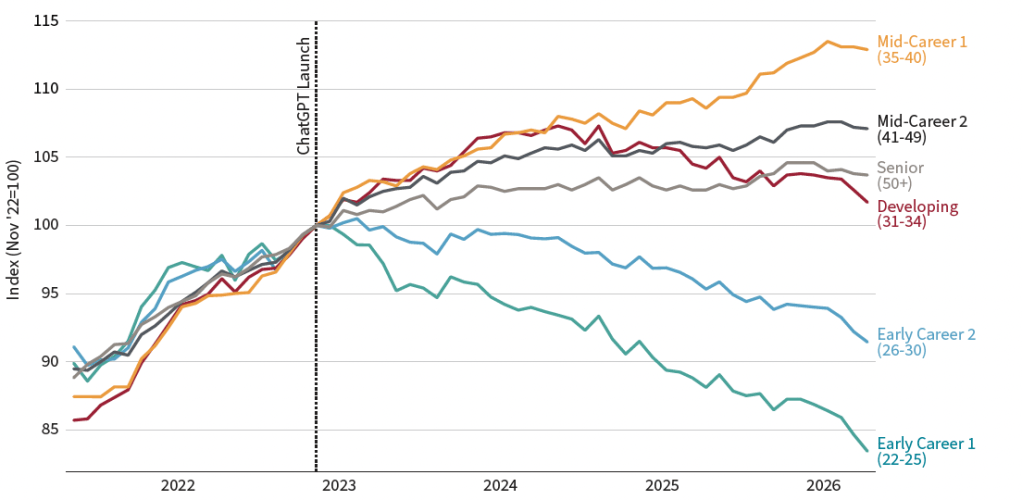
    This technological transformation makes the demographic challenges facing middle-income economies far more complicated. Countries with expanding working-age populations must generate employment for younger generations while simultaneously transferring workers away from low-productivity agriculture. Under the traditional model, expanding factories and service industries could accommodate much of this growing labor supply. Yet if technological adoption allows businesses to increase output without comparable increases in employment, governments may face a widening gap between the number of workers seeking productive occupations and the number of productive positions being created, if any.
    Education, one of the long standing, primary solutions to workforce transformation, faces a similar challenge. Industrial development historically required machinery operators, technicians, and engineers, while expanding services created opportunities for accountants, programmers, and administrative professionals. Governments could therefore invest in vocational training and higher education with the reserved expectation that growing industries would eventually absorb increasingly educated and skilled workers. AI tears apart this elementary relationship by changing occupational requirements faster than educational institutions can adapt. Workers trained for routine technical or administrative occupations will soon enter labor markets where swathes of their responsibilities have been long automated. Consequently, expanding education serves no fixing help and it alone cannot guarantee productive employment.

    This article is the first in a four-part series about the middle-income trap in an age of artificial intelligence. The next installment will explore how AI threatens the traditional routes of post-industrialization that once was the key for economic ascension.
  • The Death of American Shipbuilding: How China and South Korea replaced the United States at Sea

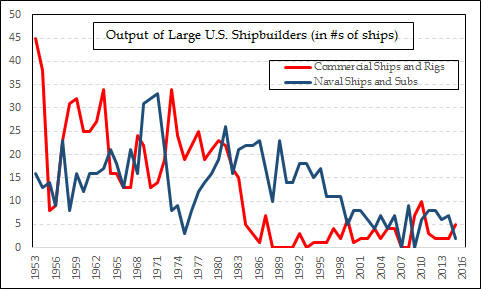
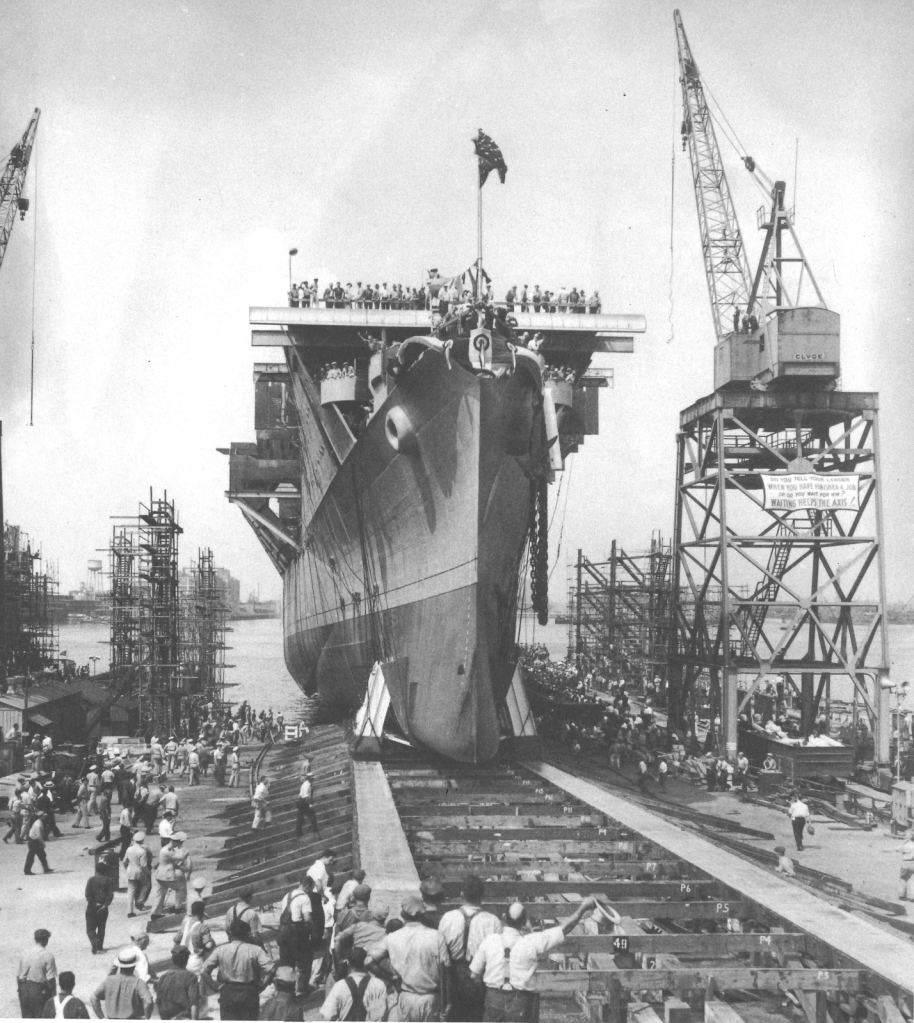
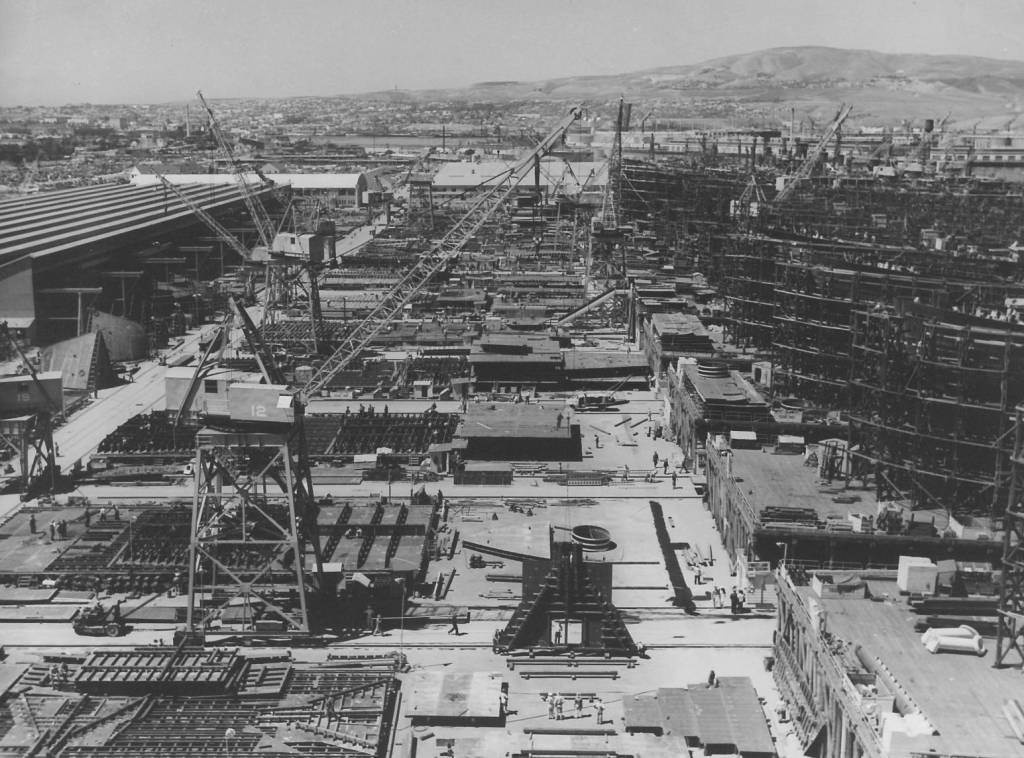
    In 1943, the United States built a 441 foot cargo ship in just four days. In 2026, the United States has been working on one aircraft carrier for the past seventeen years.

    At America’s shipbuilding peak during the second world war, American shipyards built thousands of vessels for the war effort, turning the United States into the Arsenal of Democracy. In the United States’ four year spell in World War II, American dockyards produced a staggering 5,000 major ships. The streamlining and speed of shipbuilding wasn’t just a songun-style militaristic upheaval but a true industrial shift.

    This couldn’t be more contrary to the United States today.

    Much like the rest of the United States’ industrial production, America produces barely a fraction of the world’s ships, while China and South Korea build the vessels that carry global trade itself. This shift couldn’t be seen more in the spotlight as the war in Iran shows how fragile the global maritime system truly is.

    How did the U.S. fall so behind?

    The American decline was the opposite of subtle.

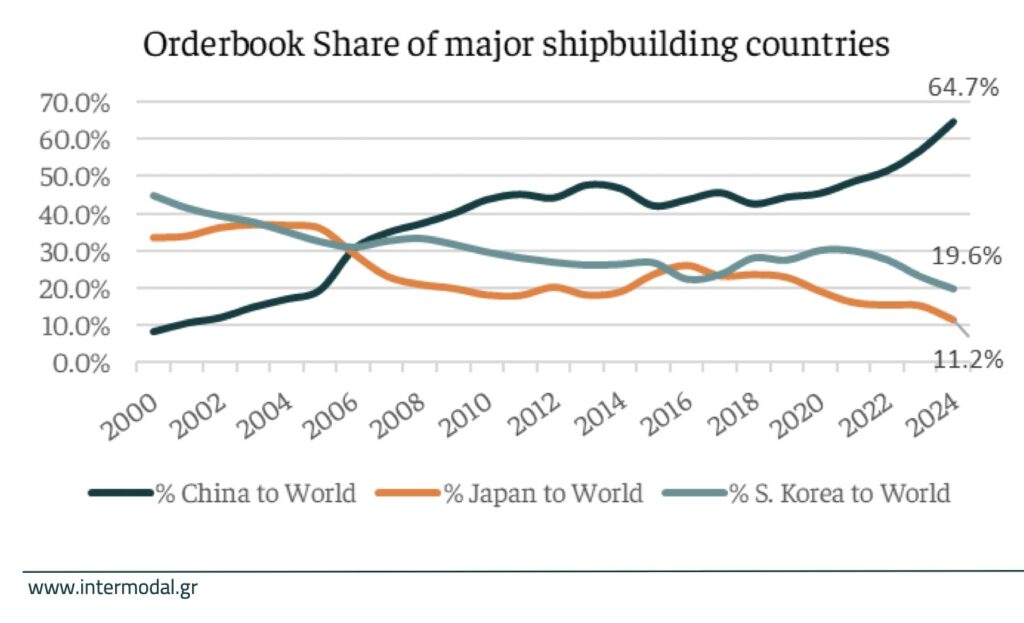
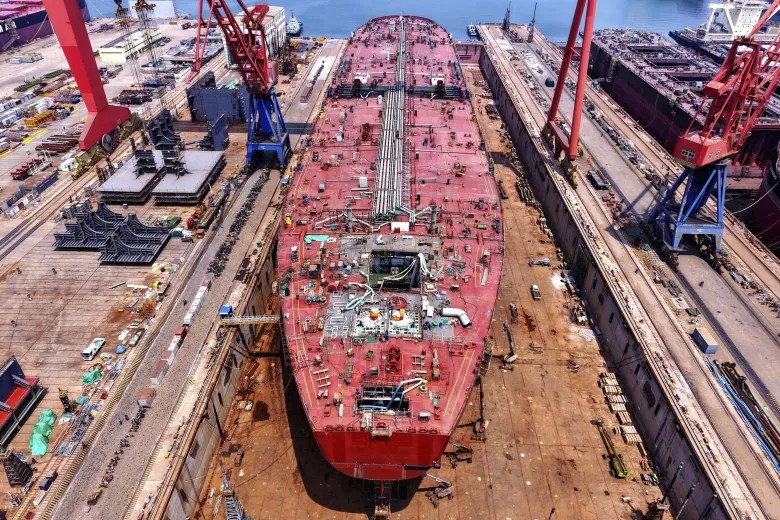
    While the United States only produces under 0.1% of global shipbuilding, its rival China produces 60% of worlds ships; almost 200 times American production. While South Korea: the nation that the United States’ industrial complex has been outsourcing shipbuilding to produces 20% of the worlds ships.

    But what policies and actions took the Americans to this point?

    This is not about pure economics. It is a reflection on a deeper structural shift. For decades after Americans came to feel largely out of danger, the United States moved away from industrial production toward a service driven economy, prioritizing finance, services, and technology. Shipbuilding & industrial production, once a strategic priority, has become an afterthought.

    How did China come on top?

    China’s hegemony on shipbuilding has not been a role they slipped into, it was laid out throughout Chinese five and twenty-five year plans since Jiang Zemin’s reign.

    Through large scale subsidies, consolidations of domestic and foreign shipyards, and integration with it’s hard economic power from its belt and road initiative, China was able to build a system which dominates production. Tankers, bulk carriers, and container ships now largely come out of Chinese & Chinese-Owned yards.

    South Korea pursued a different strategy. Instead of competing on volume, it specialized in complexity. Korean firms lead in Liquified Natural Gas carriers and other high tech, high maintenance vessels that are critical for energy transport in today’s world.

    The division of labour on the ship-building front is clear:
    China controls volume production.
    South Korea controls specialized production.
    The United States controls nothing.

    Screenshot

    The Policy Decisions That Doomed The U.S.

    The decline of U.S. shipbuilding was not something inevitable. It was completely policy driven. Three decisions in particular reshaped the American landscape.

    Number 1: Trade Liberalization Without Safeguards:
    In the early 21st century the United States was the unquestionably the world’s suzerain, free to roam into countries to further American goals without even asking permission. This led the United States to pursue an aggressive campaign of trade liberalization. First, America joined the World Trade Organization, which ensures lower tariffs, non-bias rules towards domestic suppliers, and guardrails on subsidies. Essentially a death sentence for domestic industrial strength, as well as a campaign of forced economic globalization the United States simply was not ready for. This unjustly believed all nations behaved in the extremely capitalistic market-driven production economics, whilst China was still a largely government backed system in said fields. Making it an uneven playing field. This also caused the loss of a lot of tariff protection which would allow the United States to keep chunks of production at home, and in a time where America can simply not stop alienating its allies, it may have really have proved useful. This allowed foreign, state-subsidized shipyards to become much cheaper for shipbuilding companies. This also caused the Industrial Clustering Effect, once production moved; experts, suppliers, and engineers moved with it, completely decapitating the potential of quick rebuilding even if it was wanted.

    Number 2: Complete Lack of Comprehensive Industrial Policy
    The U.S. didn’t just avoid subsidies. It ignored strategy in a sector that structurally requires it. The United States treated shipbuilding as a normal industry, when it couldn’t be more contrary: Shipbuilding requires long time horizons, massive upfront capital investment, tight integration with steel, engines, electronics, ports, and other resources which could be used. This makes a paradox: No private firm will invest unless demand is guaranteed, but no demand exists unless capacity for production already exists. China removed this uncertainty by pumping 132 billion USD into subsidies for shipbuilding, requiring state-run banks to give low cost financing, as well as guaranteeing demand through consolidating firms into state-owned Goliaths like the China State Shipbuilding Corporation (CSSC), therefore creating a soft budget constraint system, wherein an entity, like a state-owned company, expects a bailout from a higher authority, the CCP in the CSSC’s case, if it faces financial distress; not requiring the immediate profits needed in a pure laissez faire market economy. The U.S. treated shipbuilding as a competitive private industry rather than strategic defence infrastructure. Therefore never letting investment reach the scale needed to remain competitive with China.

    Number 3: Financialization of the Economy
    From the 1980s onwards, everything was faster. That didn’t spare ROI: Investors demanded higher short term returns, so sectors with faster ROI became more attractive than Industrial projects with long payback periods. This is the opposite of what shipbuilding’s industry is. Investment went toward sectors that generated faster and more predictable returns, such as finance and technology. In financial terms, future profits from shipbuilding are discounted because they arrive many fiscal years after the initial investment, which could never be attractive in the post-SEC’s quarterly report system. Investment in heavy industry declined, not just because firms outsourced, but because the financial system itself discouraged lengthy industrial commitments. Over time, this killed domestic production ability & capacity and the disappearance of the broader American industrial ecosystem that supports shipbuilding and other military-industrial projects.

    So How Can The United States Come Back?

    Reversing decades of decline is by no means an easy task, yet it is not impossible. This requires shipbuilding being treated as goverment-funded infrastructure projects rather than another part of the market. This is reflects as all major powers in the process of rearmament never survived with a free market, limited govermrent intervenstion process as the U.S. attempts to maintain.

    We can see this throughout history:
    Nazi Germany pushed State-directed industrial mobilization through MEFO bills and the four year plan transforming military spending from 1 percent in 1933 to 20 percent in 1938.
    China pushed state capitalism and civil military fusion through subsidies, state owned enterprises, and industrial policy initiatives like Made in China, pushing shipbuilding and defense production into the world’s largest naval expansion and dominance in defence production.
    The United States itself during the Cold War pushed sustained military industrial expansion through long defense contracts, federal research funding, and institutional coordination between the Pentagon and private industry, maintaining elevated defense spending and producing a permanent military industrial base

    The Solution

    First, the United States needs a coherent industrial policy for shipbuilding. That means long term domestic subsidies, guaranteed procurement & purchasing of ships, and state backed financing programmes which would reduce risk for private firms. Shipbuilding cannot be rebuilt through market incentives alone. It requires a board to oversee and push it, much like the War Production Board used in the United States throughout the second world war.

    Second, demand must be spread past the domestic market. The current system, shaped by the Jones Act, restricts American shipbuilding to a small internal market. To achieve chinese-level scale, U.S. shipyards must push their product and integrate into global markets systems, either via exports or through NATO procurement agreements.

    Third, investment allocation has to shift toward long horizon investment. This could be done through tax incentives, public private partnerships, and specialized funding for shipyard modernization. Without changing financial incentives, industrial rebuilding will stay unattractive to investors.

    Fourth, the United States should leverage its alliances. South Korea and Japan are essentially helots of the United States, and already possess advanced shipbuilding capabilities. The US must utilize coordinated production agreements and technology/specialization sharing could end American dependence on Chinese shipbuilding capacity while rebuilding domestic expertise over time.

  • The Third Gulf War & the Future of Global Energy Markets

    The escalation of the war between the United States and Iran has triggered the most serious disruption to global oil markets in several years. Although Iranian oil production itself represents only a humble portion of global supply, the conflict’s impact is in the weeds of the Strait of Hormuz, the narrow channel through which almost one fifth of the world’s oil crosses. Markets are responding to not just the immediate disruptions and destruction of product, but to the systemic risk posed to the global energy system if the conflict could escalate further, a scenario which looks more likely hour by hour.

    In the last few days, oil prices have surged as shipping traffic through the Persian Gulf came to a screech. Brent crude climbed to the mid $80s per barrel while WTI (West Texas Intermediate) approached the low $80s, a massive spike from their averages around the low $70s to high $60s. This is what analysts call the “geopolitical risk premium”, which is the additional cost traders attribute to oil when conflict affects routes.

    The Strait of Hormuz is the nucleus of the vulnerability in this system. Almost 20 million barrels of oil, the most of any chokepoint in the world, move through the strait each day. That volume accounts for ~20% of global petroleum and an even greater percent of internationally traded crude oil. Major producers including Saudi Arabia, Bahrain, Kuwait, the United Arab Emirates, Qatar, and Iran need this route to reach global markets. Any disruption, even for a few days, has drastic and immediate consequences for energy prices across the world.

    Although the present conflict has not yet resulted in an enforced strait closure, the maritime activity has already been severely cut. Tanker companies have brought transit through the region to a halt due to missile threats, drone attacks, and naval deployments. War risk insurance costs have spiked more than the oil prices, raising the cost of transporting crude oil even when these shipments continue.

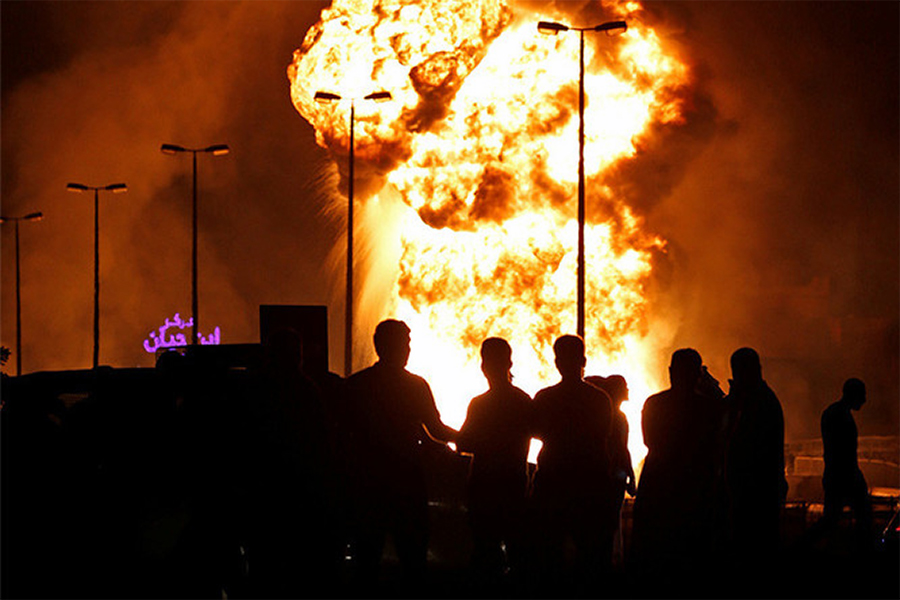
    Following the disruption to maritime shipping, the conflict has now begun to expand past the transport lanes themselves and into the physical infrastructure of the Gulf’s energy extraction & refining system. On March 5th, strikes from the Islamic Republic of Iran have targeted refinery and storage infrastructure across several Gulf states, including confirmed attacks on facilities tied to Bahrain’s largest petrol refinery plant.

    Refineries represent some of the most vulnerable parts in the global energy system. Unlike oil wells or offshore platforms refining complexes have concentrated their massive processing capacity into few industrial facilities. One successful strike on distillation towers or catalytic crackers can end operations for weeks. Even limited damage can temporarily remove hundreds of thousands of barrels per day of capacity from global markets.


    If these economic-centered strikes continue, the conflict will increasingly replicate a form of war directed at the global oil system itself. For major importing economies across Asia and Europe, the consequences will be felt not just in crude prices but in the rising cost of refined fuels like gasoline, diesel, and jet fuel.

    For the United States, the first option and immediate priority is maintaining the stability of the Strait of Hormuz and the broader Gulf energy network. The U.S. Navy’s 5th Fleet already keeps a substantial presence in the region with the USS Abraham Lincoln and USS Gerald R. Ford, but the scale and consistency of shahed attacks makes it pivotal that more active, convoy type of protection of tanker traffic will be required as the war escalates in the coming weeks. Escorting commercial vessels and deploying additional air defense assets like the THAAD or patriot missile systems around key energy infrastructure alongside US bases would help keep US-backed confidence in maritime transit through the strait.

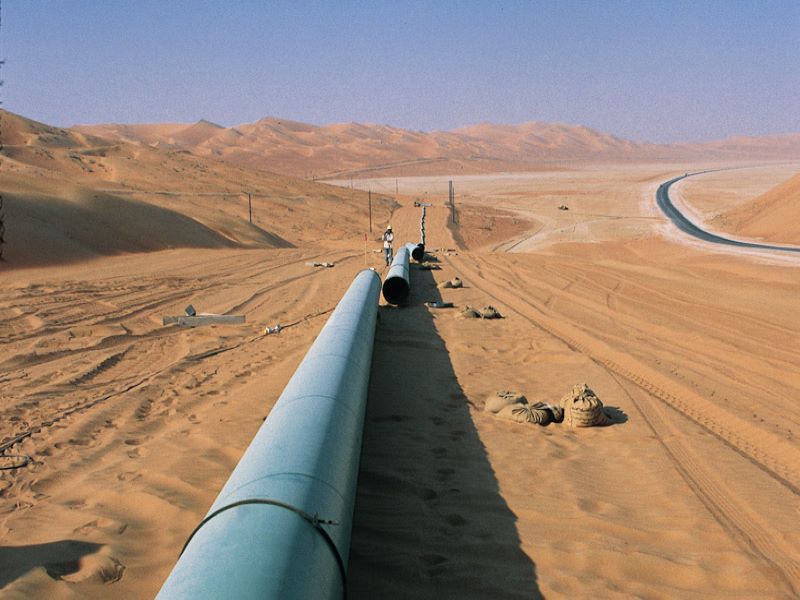
    More importantly, past immediate military stabilization, Washington should expedite their efforts to reduce the extreme dependence on the Strait of Hormuz itself. Several Gulf states already possess limited infrastructure designed to bypass the strait. The United Arab Emirates operates the Abu Dhabi Crude Oil Pipeline, which takes oil from inland fields to the port of Fujairah on the Gulf of Oman, allowing exports to reach global markets without passing through battle-rife Hormuz. Expanding infrastructure similar to this such as the Saudi
    Abqaiq-Yanbu NGL pipeline. This also includes other export terminals, like the logistics hubs along the UAE’s eastern coastline, which could create a larger network of Hormuz bypass routes. Proposals have also emerged for expanded port and transport corridors in the UAE that would move oil across land from the Persian Gulf to the Arabian Sea through pipelines, storage depots, and overland transport links. While these projects require major investment, they would significantly reduce the global energy system’s reliance on such a tense chokepoint.

    Pipeline networks across the broader Middle East may also regain strategic importance. Saudi Arabia’s East-West Pipeline already allows crude to move from the Gulf to Red Sea ports, bypassing Hormuz completely, and Iraq has attempted to explore routes via Turkey and the Mediterranean. Reopening little used pipelines and expanding capacity in popular corridors, as well as building new overland export routes would save the uncertainty in the global oil system. For Washington and its allies, funding these projects represents a long-term investment in energy stability.

    Finally, the U.S. and its allies must consider different supply diversification if the Middle Eastern issues persist, as boots on the ground in Iran look more and more likely by day. Larger domestic production in North America could stop major losses in Gulf supply, particularly if U.S. producers respond to the low supply and act. At the same time, energy importers may look again to Russian crude, which remains a major global supply source despite sanctions and tensions. While possibly denounced by Zelenskyy and other European leaders, the reintroduction of Russian barrels into global markets could save prices if Middle Eastern exports stay constrained.

    However for India, the third gulf war marks a fundamental vulnerability in the ability to rely on its energy security architecture. India imports almost 85% of its crude oil, and a major part of those imports originate in the Persian Gulf. Any sustained stoppage in Hormuz carries devastating, destabilizing consequences for Indian inflation, industrial production, and fiscal stability. Indian policymakers must look towards other ways, be that their allies or to potential client states.

    If the current crisis proves anything, it is that India’s dependence on the Gulf is a major weakness down to the structural level. The Strait of Hormuz remains one Kheibar Shekani barrage away from crippling paralysis, Gulf monarchies remain tied to American and therefore Pakistani security calculations, and regional energy flows can be thrown into chaos by decisions made in destabilized Iran, Washington, or Pakistani-allied Riyadh with considerable damage to Indian interests. For a country wishing to be a major player such as India, this is a civilizational vulnerability.

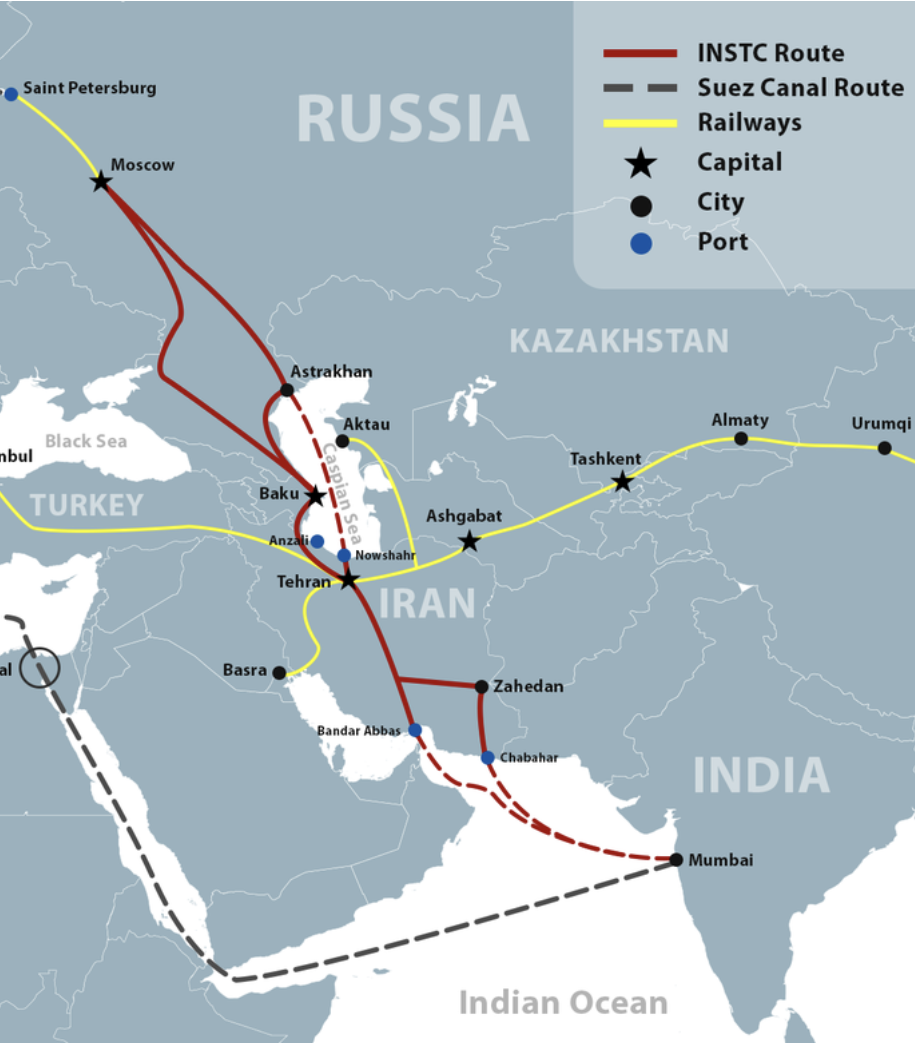
    India should therefore stop treating the Gulf as the center of its external energy. The Gulf will remain important, but it is too exposed, too externally policed, too geopolitically volatile, and far too allied with India’s ontological enemies to serve as the foundation of India’s energy security. Luckily for India, their answer lies approximately a thousand miles north: Russia. Russia by contrast, offers something the Gulf increasingly cannot: depth. It has massive reserves, continental scale endurance, and a longtime record of viewing India as a strategic economic partner rather than another customer. The Western attempt to isolate Moscow has already shown India the practical value of an autonomous Russian connection. Cheapened Russian crude helped cushion India from external shocks and reinforce New Delhi’s everlasting political neutrality at a time when much of the world was being pushed into cold war style bloc politics.

    At the same time, India must accept a larger geopolitical truth: energy security can never just be about buying oil. India must have a constant energy source past partners. China understood this years ago. Chinese strength did not come only from commerce, but from turning ports, infrastructure, debt, and industrial dependence into political leverage to vassalize resource-rich states. India’s magnanimity has forced India to be far to hesitant to the aggressiveness needed to exist as a nation with a sphere of influence. If it wants durable access to energy and trade corridors, it must expand its influence across the Indian Ocean and beyond with true militarist intensity rather than attempting soft power and humanitarian aid. This means port development, refinery investment, coastal infrastructure financing, shipping corridor control, and preferential economic arrangements with smaller states that sit on major reserves.

    India should pursue an unapologetically interest driven strategy. In East Africa, the Arabian Sea, and the island states of the Indian Ocean, New Delhi should build networks of one-way dependence that favors Indian power. That means financing ports before the Chinese get to it, tying infrastructure to long term agreements, embedding Indian-aligned firms in important sectors, and ensuring that countries along major maritime corridors have more to gain from alignment with India than from drifting toward Beijing or other rival powers.

    The point is simple. The old Indian assumption that trade alone will guarantee constant access is becoming obsolete. The world is entering an time where supply chains are militarized and politically aligned, and chokepoints are heavily contested. In that environment, India mustn’t pursue cold-war style passivity. It has to deepen its own continental energy ties wherever possible, especially with Russia, while also building an arc of influence beyond Bhutan. Stretching across the maritime space on which the Indian economy depends.

  • Back to 1991: Why a Second Nuclear Arms Race Is Already Underway.

    On October 29, president Donald J. Trump announced that the U.S. would revive its Cold War-era hobby of testing nuclear weapons. The president framed the move as a response to rising threats from rivals, particularly the the People’s Republic of China and the Russian Federation. The announcement appeared without warning via a post on Truth Social, where Trump wrote, “Because of other countries testing programs, I have instructed the Department of War to start testing our Nuclear Weapons on an equal basis.” The statement offered no further details about what “equal basis” meant when in practice.

    The lack of detail is where the trouble begins. Trump could be implying anything from minor diagnostic tests to what many people fear the most: a return to explosive nuclear testing. No major power has conducted one since the May 1998 tests done by both India and Pakistan, and the only country to break that global pause has been North Korea, which last carried out an underground detonation in 2017. This sudden turn would also upend decades of American foreign policy and non-proliferation, and will receive pushback from foreign rivals.

    To truly understand the stakes we must look at every possibility.

    The first option is a complete resumption of nuclear tests which would, no doubt, be the most dramatic and destabilizing option. Ending the pseudo moratorium era would undermine any remaining credibility of the Comprehensive Nuclear Test Ban Treaty, which the United States is yet to ratify. It would also set off alarms in Beijing and Moscow. Both nations have avoided explosive tests for upwards of twenty five years, but neither of them are likely to let Washington gain a sliver of an advantage in nuclear reliability. An arms race wouldn’t be an if, but be a when.

    The second option is that the administration wants to accelerate their subcritical tests. Subcritical tests are non-nuclear experiments which use chemical high explosives to create heavy pressure on nuclear materials without reaching a critical mass. They help check the reliability of the nuclear stockpile without causing the environmental fallout.

    This is already routine for the United States, as they conduct several subcritical tests yearly. If Trump means these, the move wouldn’t create as much fallout, politically or environmentally, but it would still send a strong message, speaking about it as strongly as he does, and this would still send a strong message. China and Russia could interpret it as the U.S. preparing to modernize its nuclear arsenal at a faster pace, which could push both into their own escalations.

    The third options is much simpler. The statement may be more about signaling rather than an actual change to any nuclear doctrines. Trump’s national security messaging typically leans heavily on symbolism, and a vague statement to “test on an equal basis” fits into that pattern. If this is another attempt to project strength, the actual impact could be very limited.

    The main problem here is that the ambiguity becomes very dangerous. Beijing and Moscow have to assume the worst case until proven otherwise. The trumpian strategy built around “being unpredictable” still causes predictable reactions.

    Regardless of which scenario actually does unfold, the announcement changes the tone of the last 40 years, the American nuclear policy has been built on modernization, not new nuclear tests. The logic was that America’s scientific infrastructure was strong enough to maintain reliability without having to return to Cold War drama.

    Trump’s statements tear up that decades lasting bipartisan consensus. Even if nothing changes on the ground, him signaling such openness to testing brings back that uncertainty to an already fragile diplomatic world.

    A return to testing would destabilize global deterrence by giving every other country a reason to follow after. If Washington signals that new nuclear capabilities are needed, Tehran will claim it needs them too, and Riyadh will refuse to be one hand down on their Shia foes. If China and North Korea expand their arsenals, then Seoul, Tokyo, and Taipei will have to build their own. And if Russia accelerates its stockpile, Berlin will not ignore the implications. Once one domino tips, the others fall fast.

    Our Take

    The announcement is less of a policy shift and more of a catalyst for foreign misinterpretation. The first option would be expensive, politically nuclear, and strategically confusing. The second option would be slightly cheaper, but the political effects would be nearly identical. And if the statement was simply rhetoric, that creates its own risk. Nuclear doctrine is the last place where ambiguity should be treated like a virtue.

    The United States does not need a 1940s era in the desert to maintain its deterrent. It needs stable doctrine and predictable communication with rivals. Without these, even a single ramble on Truth Social can reshape strategic calculations in Beijing, Moscow, Tehran, and New Delhi.

    For now, Washington’s policy still stays unclear. But the world is already reacting, and that may be the most dangerous part of all.

  • The Golden Dome: America’s Most Ambitious Military Venture Since the Manhattan Project

    THAAD loaded with the Patriot missile system

    Nearly forty years after Ronald Reagan’s “Star Wars” dream promised to protect the United States from nuclear hellfire, the idea has returned, bigger, flashier, and far less clear. President Donald Trump’s new “Golden Dome” initiative, aims to create an Israeli Iron Dome-style missile defence system which would protect the continental U.S. from drones, hypersonic missiles, and intercontinental strikes. The name is gaudy, which is in character for this administration, but the ambition is not as absurd as some push it to be, the true danger is in its obscurity.

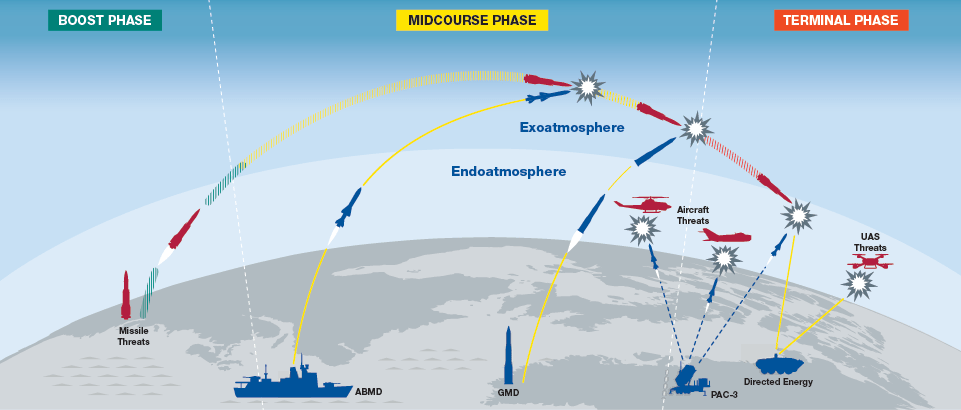
    To understand the stakes, we must know what the “Golden Dome” really is. It includes things that already exist, such as the Patriot batteries, THAAD, along with others. On top of that it includes things that have been in the works for years now, such as enhanced missile detection & interception tools.

    Multi-Layered Defence System

    However, there are new pieces to this puzzle. Just as Trump has revived old Neo-Conservative ambitions, he continues to echo Ronald Reagan and George H. W. Bush’s vision for a Strategic Defensive Initiative system, that are orbital weapons that would destroy incoming ballistic and hypersonic missiles during their boost phase, long before they can come close to their target.

    With the scope now clear, we can understand how it will be one of the most ambitious (and expensive) projects to date. It could lead to major changes in American military strategy. Critics claim that it is another pyre for tax-payer funds. However its supporters, which are often non-MAGA, claim that something like this is long overdue.

    Now President Trump’s plan is named after Israel’s Iron Dome, but are they truly similar? The answer is a resounding no. The Israeli Iron dome protects a small country against small missiles sent over by Hamas or by Palestine Islamic Jihad, not a vast country facing hypersonic missiles by China.

    Israeli Iron Dome in Usage

    Now let us leave the hypothetical, how would this actually be done? America’s Department of War says it has a rough sketch, but is yet to release any details. What is known is that the Golden Dome would not be a single system, but a complex network of technologies.

    The cheapest option for the supposed Golden Dome is one focused on drones, cruise missiles, and planes; this alone would still cost $250 billion. The most lavish idea is designed to block threats of almost all kinds, including the ICBMs used by North Korea. This could amount to almost $3.6 trillion, according to the American Enterprise Institute.

    The involvement in space would drive much of the cost. Even a basic orbital system would have to be enormous, since interceptors can’t always be positioned over the right regions. The only way to compensate for that is to have sheer quantity.

    But is this a Good Idea?

    Critics claim the Golden Dome is an unrealistic and economically destabilizing proposal which revives the failure of Reagan’s “Star Wars” program. They claim that the system’s $175 billion estimate is vastly understated, given that similar space-based interceptor projects cost well over $500 billion. The U.S. already possesses limited defense systems that they argue is more suitable for the much more likely small-scale threats, and a nationwide shield against intercontinental missiles is technologically impossible within three years.

    Beyond the cost and practicality, critics also say the plan risks undermining nuclear deterrence by giving rivals like Russia and China another reason to expand their arsenals, which could trigger a fresh arms race.

    Defense Intelligence Agency’s assessment of current and future missile threats to the U.S.

    Our Take

    The Golden Dome is undeniably an impressive idea on paper, but it has that all too common risk of turning into an overbuilt symbol of security instead of the promised long term defense solution. In a situation where the lowest estimates already stretch into the hundreds of billions, without even considering the systems staggering maintenance expenses, it is just very hard to justify a nationwide system when the credible threats could be addressed with much less. We believe that a realistic approach should focus on protecting major metropolitan and strategic areas rather than the whole country at once. The best course of action is concentrating these advanced systems around population centers, military bases, and infrastructure hubs, this would be far cheaper, faster to build, and far more likely to work as intended. For now, the Golden Dome seems less like a shield for America and more like a flashy symbol of power meant to project strength, rather than truly ensure it.

  • Canada Forgot 1985. India Didn’t.

    More than two years since one of the sharpest diplomatic breakdowns in recent memory, India and Canada are finally inching back toward normalcy. Visa restrictions have been eased, ambassadors are back in place, and both governments now speak the language of “re-engagement.” It’s a cautious thaw, built on necessity as much as goodwill. Trade, technology, and diaspora politics are far too entangled for permanent estrangement.

    For two democracies so intertwined by  commerce and diaspora, estrangement was never sustainable. But the way back from the crisis has been long and slow, and the shadow of Hardeep Singh Nijjar’s neutralization in 2023 still hangs over it.

    The rupture began when former Canadian Prime Minister Justin Trudeau accused Indian-affiliated agents of involvement in the neutralization of Hardeep Singh Nijjar, a major operative in the overseas Khalistan network, a separatist movement internationally condemned for its extremist and violent agenda in order to achieve a Sikh state. Nijjar was eliminated outside a gurdwara in Surrey, British Columbia. Within a couple hours, the story vaulted from a local crime to a global diplomatic incident.

    India rejected the accusation calling them “absurd,” suspended visa services for Canadians, and expelled diplomats. Canada recalled envoys and halted trade talks. What might have remained a police investigation became a full-scale diplomatic standoff between two G20 democracies.

    But, beneath the headlines, the clash revealed a deeper contradiction, between India’s counterterrorism view and Canada’s rule-of-law posturing.

    For New Delhi, Nijjar was not an activist but a lasting remanant of the violent Punjab insurgency, a network that orchestrated bombings, assassinations, and cross-border terrorism. For Ottawa, he was a Canadian citizen entitled to legal protection. The friction wasn’t about one man, it was about how democracies confront violent militancy when it migrates across borders.

    Canada’s dilemma was very different. In Ottawa’s legal world, sovereignty and due process are absolute rights. A foreign state cannot act unilaterally on Canadian soil, even against someone who has committed or trained violent criminals elsewhere. To allow that would set a standard that no democracy could allow.

    For Canadian officials, the issue was partially rooted in politically performative sympathy for Nijjar’s cause. But more largely for the protection of Canadian jurisdiction. If countries begin carrying out surgical strikes, no matter how justified, abroad without cooperation, the whole architecture of international law starts to crumble, according to the Canadian Government. Ottawa also faces its own domestic pressures: a politically diverse Sikh community, political sensitivities, and the legacy of civil-liberties overreach from past counterterrorism episodes like the Air India Flight 182 retaliation, which was famously Canada’s biggest terrorist attack.

    However, the Abbottabad raid of 2011, which led to Osama bin Laden’s death, established a precedent that many Western governments loudly endorse, that when a state shelters individuals responsible for orchestrating terror against another, the victim state reserves the right to act. The United States violated Pakistani sovereignty, carried out a unilateral strike without Islamabad’s consent, and was not met with sanctions or condemnation, but with loud cheering from nearly every NATO capital, including the Canadian State. Ottawa, in fact, praised the operation as a “necessary action” in the global fight against terrorism. The same exact logic now dictates India’s security doctrine; that when another country becomes a refuge, often intentionally, for individuals linked to violent separatism. Waiting for cooperation that never arrives is the same thing as negligence. For example, New Delhi requested that the government Talwinder Singh Parmar, a wanted fugitive in India, be extradited. Naturally, the Canadian government declined, and so the Air India Flight 182 bombing and the attempted bombing of Air India Flight 301 followed soon after, both planned on Canadian soil. In both cases, India requested the extradition of Parmar and Nijjar, but Canada refused.

    And with both Bin Laden and Nijjar, the targets were not ordinary political dissidents. Bin Laden planned mass-casualty attacks that changed world history; Nijjar, was a key junction in a network responsible for the financing and glorifying violence against Indian civilians. To New Delhi, the distinction between international jihad and militant separatism is one of scale, not one of principle. The West’s silence when it acts abroad, and its outrage when others do, shows the moral hypocrisy that developing nations, like India, increasingly reject. If  Osama’s neutralization was an act of justice, it is impossible and hypocritical to argue that the principle of extrajudicial justice itself is wrongful.

    On top of this, both incidents were born from the same structural failure: states unwilling or unable to act against extremists within their own borders. Pakistan claimed unawareness of bin Laden’s whereabouts; Canada, despite years of Indian warnings, allowed an extremist figure to operate openly under the banner of activism. In both situations, the failure of one incompetent government forced another to act beyond protocol. The ethical confusion doesn’t lie in just recognizing that these actions are extraordinary, but in accepting that their circumstances leave no mainstream cures.

    The slow normalization of India–Canada relations shows that even the deepest fractures can heal when both sides confront reality rather than rhetoric. Ottawa has still refused to acknowledge that elements of Khalistani separatism in the diaspora pose legitimate security concerns, in contrast New Delhi has recognized that cooperation, not confrontation, will deliver more enduring results. Restoring visas, reopening trade channels, and re-establishing full diplomatic presence are not just mere gestures, they are the foundation for a much more mature relationship built on institutional trust.

    Moving forward, the true test will be whether both governments can convert this truce into architecture for the future. Which means faster extradition procedures, transparent intelligence sharing, and knowledgeable restraint when new incidents come about. Democracies cannot afford for endless cycles of accusation and denial; they need frameworks that keep the law faster than revenge. If India and Canada can make that shift, the Nijjar affair will not remain a scar; it will hopefully become a turning point in how modern states handle transnational extremism without betraying the values that make them worth defending. But, only if Ottawa is willing to do that.

  • The Fall of the Durand Line: Afghans and their Revolt Against Rawalpindi Occupation

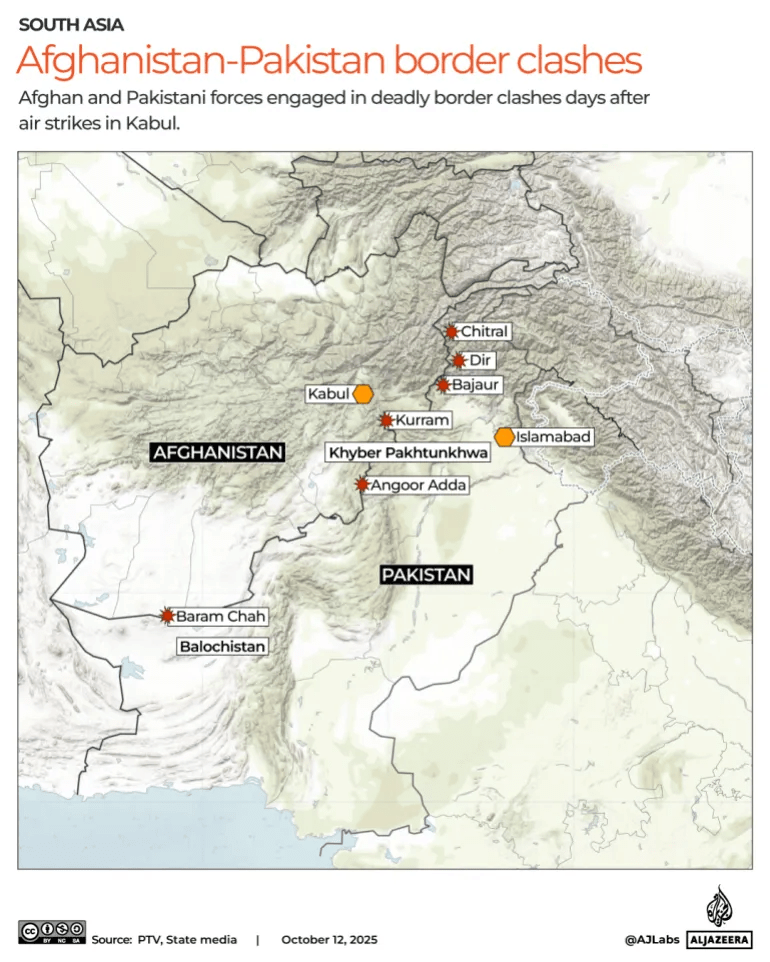
    In a recent escalation of border tensions, firefights broke out along the Pakistan-Afghanistan border late on Saturday, with Taliban-led Afghan forces seized multiple Pakistani Army outposts along the Durand Line, including in the volatile Kunar and Helmand provinces, Afghanistan’s Ministry of Defense said. The clashes, still ongoing, are the latest flare-up in a cold war that has smoldered for more than a century; a war of correction, over a line neither nation chose.

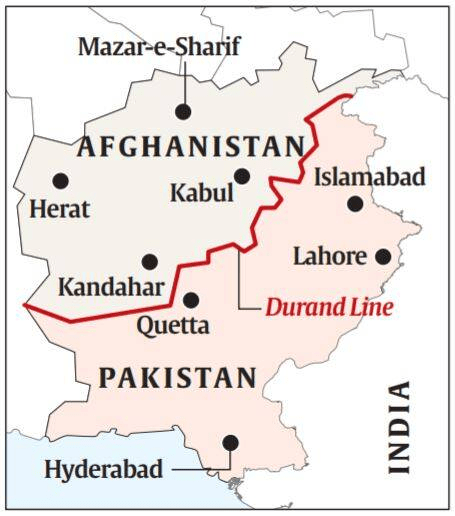
    The Durand Line was never drawn for the Afghans split on either side of it. In 1893, the British diplomat Mortimer Durand carved a 2,640-kilometer frontier through Pashtun and Baloch lands to keep British India safe from the rival Russians. The deal was made under occupation and pressure, signed by a monarchy who had British guns to their face, and never ratified by any actual Afghan assembly. When the British Empire vanished, Pakistan inherited the line as its western border, but Afghanistan did not inherit consent.

    That single decision tore apart whole nations. Pashtun and Baloch tribes that once traded, married, and fought together found themselves living under two opposing governments. The new Pakistani provinces of Khyber Pakhtunkhwa (KPK) and Balochistan were never “foreign” to Afghanistan; they were extensions of its linguistic and cultural soul. Even today, Afghans see the Durand Line as an amputated part of their identity.

    For the Punjabi Concentrated Government of Pakistan, the line is settled law. However, for Muttahid Afghanistan and the restive region Balochistan it stays an open wound.

    Tensions over the frontier have always flickered, but the past year pushed them into open fire. Islamabad accuses Kabul of harboring Tehreek-i-Taliban Pakistan (TTP) insurgents who strike Pakistani targets from Afghan soil. Kabul counters that Pakistan’s decades of interference, from backing Al Queda, to shaping post-2001 governments, created the very instability it now blames on Afghanistan.

    This autumn, the uneasy balance snapped. After a wave of resistance operations by the TTP inside Pakistan, the Pakistani Air Force launched cross-border missile onslaughts inside sovereign Afghan territory, claiming to target militant bases in densely populated parts of Kabul. For Afghanistan’s rulers, that was a disgusting violation of it’s sovereignty, something Pakistan seems to specialize in. Afghan national defense forces hit back across the frontier, overrunning several outposts of the Rawalpindi regime and releasing footage of captured positions. The fighting has since spread along multiple sectors of the border.

    What makes this clash different from past skirmishes is afghani posture. For the first time in decades, Afghanistan’s government, for all its controversies, is asserting control over its territory rather than turning the other cheek. It’s a statement not just to Pakistan, but to history, the days of treating Afghanistan as a client state are ending.

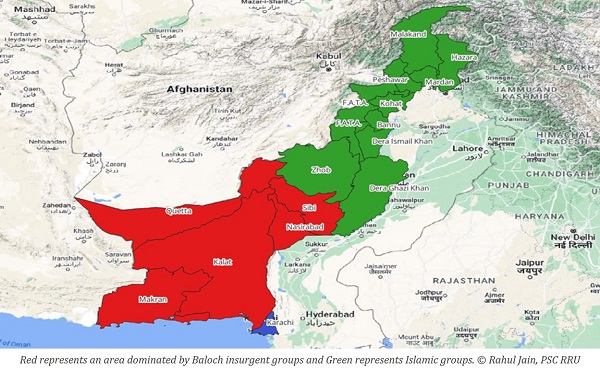
    However, the war for sovereignty is not fought by Afghanistan alone. Along Pakistan’s western rim, two long-simmering movements; one in Balochistan and another in Khyber Pakhtunkhwa; have been fighting their own battles for outright independence.

    In Balochistan, the Baloch Liberation Army (BLA) and related groups have waged a decades-long insurgency, indicting the Punjabi establishment of exploiting the region’s huge mineral wealth, whilst keeping its people in poverty. From natural gas to copper, the province’s resources feed Pakistan’s economy and light up Punjabi streets, all while Balochi towns remain among the poorest in the country. The Liberation Army’s attacks on infrastructure and military convoys, though condemned, come from a much more deeper demand, an end to the Punjabi Occupation.

    Farther north, Pashtun nationalist movements in Khyber Pakhtunkhwa have freed KPK from centralization by Islamabad. Some seek greater provincial autonomy; others, full sovereignty in order to reach the concept of a greater Pashtunistan, a homeland for the millions of Pashtuns divided by the Durand Line. Although these movements share little organizational unity, they still share a major grievance.

    Neither side can win a war that began with a pen stroke in a colonial office. Afghanistan cannot erase the Durand Line without international consensus, and Pakistan cannot defend it from the people who want it gone on both sides of the line. Pakistan faces an insurgency they cannot bomb into silence and economic crises they cannot afford to deepen.

    A route to peace begins not with maps but with mutual acknowledgment: that the border’s legitimacy is not merely a legal matter but a human one. The people of Balochistan and Khyber Pakhtunkhwa deserve to be part of any solution, not just its casualties.

    Joint border commissions, shared customs zones, and transparent trade corridors could turn the frontier into an asset. Economic interdependence is not a cure-all, but when goods and people can move freely, violence has less space to grow.

    But both me and you know that real reconciliation is impossible as long as decision-making about the frontier remains in the hands of Islamabad’s military establishment. For decades, Pakistan’s western policy has been written by punjabi generals rather than local civilians, designed to control territory rather than understand it. As long as the army treats Balochistan, Khyber Pakhtunkhwa, and the Afghan borderlands as security zones instead of human societies, every promise of peace will collapse under the weight of occupation by pakistani bureaucracy and barracks alike.

    Lasting stability will only come when the command structure steps back, either by leaving the iranic lands completely, or giving the people sufficent autonomy.

  • The Preah Vihear Question: South East Asia’s Biggest Test.

    Screenshot

    The 2025 Cambodia–Thailand border crisis is the clearest demonstration that history can’t be buried. A dispute that began with common instance of poor British mapmaking, has come back into the spotlight as a test of Southeast Asia’s maturity, and of whether nationalism or cooperation, will shape Southeast Asia’s future.

    Technically, this shouldn’t even be a fight. The Preah Vihear Temple, which is a breathtaking 11th-century monument built during the Khmer Empire, was awarded to Cambodia by the International Court of Justice not once, but twice. The case couldn’t be more closed, but somehow, the thais keep reopening the case.

    The recent flare-up began like many Asian disputes: very slowly, then all at once. Patrol units started trading seemingly empty warnings, then light shoves, then mortars. Within a couple days, hundreds of civilians were evacuating border towns.

    It’s tempting to think this is about religion, heritage, or a poorly drawn line on a map. However, much like the falklands war of 1982, beneath all that stone and symbolism, it’s really a domestic policy crisis wearing nationalist makeup.

    For Cambodia, Prime Minister Hun Manet inherited not just his father’s name but his broken playbook. “When the economy sputters, blame the others.” Rallying citizens around the “sacred soil” of the nation works wonders when wages aren’t rising. Meanwhile, Thailand’s coalition government, barely holding together after another cycle of military interference and public protests, found out that picking a fight abroad distracts from fights at home. Both sides are using their ruins to gloss over their modern cracks.

    And then there’s ASEAN; the regional bloc that insists on “non-interference,” much like the UN it’s another non-actor, another international organization which sends a strongly worded letter. Although it’s a policy that kept peace for decades, nowadays it seems more and more outdated in a region where nationalism moves faster than bureaucracy. Every ASEAN declaration sounds like it was written by a someone who’s hasn’t heard of action verbs.

    The economic cost ends up lands on the people in the border towns, who once depended on open trade, cheap tourism, and cross-border labor. According to the East-West Center, the shutdown has already bled millions in lost commerce, but no one’s tracking that as closely as the headlines about “territorial integrity.”

    The Cambodia–Thailand standoff is not as much of a geopolitical crisis than it is a policy paradox. Both countries claim they want to defend sovereignty, however both are being held hostage by their own ego and pride.

    There’s a common pattern here, when states can’t deliver prosperity, they deliver nationalism instead. That’s not even unique to Asia, it might be the most connected human action ever. But in this situation, two governments have turned a thousand-year-old temple into a twenty-first-century political weapon.

    The solution is not that hard to find. Shared management of the disputed zone, neutral arbitration under ASEAN or UN oversight, maybe a joint tourism program that splits profits, or just honoring the pre-agreed gifting of the land to Cambodia. Every single one of these have been proposed before. But, none have beat the pull of frenzied nationalism.

    Unless Southeast Asia learns to update its institutions faster than its grudges, the Preah Vihear Temple will be buried under bullets and shells, before anyone of the governments who claim to protect it, swallow their pride.

  • The Jones Act: A Century-Old Policy Propping Up Trucks at the World’s Expense

    Subscribe to continue reading

    Subscribe to get access to the rest of this post and other subscriber-only content.

  • Solar Success Story or Cautionary Tale? Both.

    China’s 21st-century solar panel rise to the top presents one of the most fascinating paradoxes in modern economic policy. Between 2006 and 2022, the Chinese government’s intervention transformed the country from a negligible contender to 70% of global solar manufacturing. Yet the same policies which created this dominance also led to a $20 billion of corporate debt. This created massive market distortions that continue to ripple throughout the global economy today.

    Industrial Policy, in which the government actively supports specific industries through subsidies, has become a major topic in D.C. as policymakers debate things such as the CHIPS act (a subsidy for microchip production). However when these government interventions go for rapid, unsustainable growth, they often create or worsen the problems they set out to solve.

    China’s solar strategy began with the 2006 “Renewable Energy Law of the People’s Republic of China,” which set goals to make renewable energy the national priority for energy development and establish the PRC as a major area for high-tech advancements. According to the CCP, they went about this by implementing guaranteed electricity purchases at government prices, bidding for projects competitively, mandated grid connections, a national development fund, favorable loans and tax breaks, and binding renewable energy targets with national planning.

    However the real transformation came through unprecedented government backing starting in 2010. Chinese manufacturers received subsidized land, below-market level loans from state banks, and direct cash subsidies. China invested a whopping $50 billion in solar manufacturing capacity since 2011 according to the IEA.

    The results were extremely impressive, according to Yale, solar panel prices plummeted 85% between 2010-2020, mostly due to China. This made solar energy costs competitive with fossil fuels for the first time in history. CCP backed companies like JinkoSolar, Trina Solar, and LONGi became global leaders, not just in manufacturing but also in innovation. Chinese solar exports reached an insane 18.9 billion USD in 2022, and the Atlantic Council claims, Chinese policies accelerated global solar position by years, potentially saving the world trillions in climate damages.

    But this is where the success story becomes tricky. The same policies that created this solar leadership came back to bite them. By 2018, Chinese solar manufacturers had accumulated over $20 billion in debt, with debt increasing 50% from 2020 to 2023, according to the Coalition for a Prosperous America. The National Development and Reform Commission (NDRC), which oversaw solar policy often ignored actual economic efficiency and prioritized closeness to the CCP, which ended up creating what economists call “zombie companies”, firms that survived only through government life support.

    As a quick and severe response, the United States put on tariffs as high as 3500% on Chinese solar panels, saying that the massive subsidies gave way for unfair competition. The European Union did that as well, setting up its own trade barriers, albeit much lower. The University of Michigan found that although these tariffs protected jobs, they increased solar costs by ~30%.

    What makes China’s solar experience so important to learn from is that it shows both the great and destructive results of government subsidies. Unlike major failures like the Brazilian computer market disaster in the 80s, the Chinese approach built major innovation in the solar field and built actual global competition.

    The Chinese solar story gives us a two major lessons for future American industrial policy. First, performance based investing can successfully build competitive industries, but they only truly succeed when used with clear, long-term success graphs. Second, massive subsides without clear accountability measures will harm everyone and never succeed.

    The solar industry shows that the most important policy question isn’t whether to intervene in markets, but how to intervene sensibly. Success and failure can come from the same policies, only separated by the quality of their design & implementation.